Lesson 1: Letter to Teacher
Lesson 1 Writing Task- Letter to Teacher
Directions: Write a letter to your teacher– an introduction, so to speak. Use paragraphs to separate your ideas.
- Tell me about your interests as a reader. What genre appeals to you? Why?
- What interests you about literature?
- What are your personal goals for this English 8 class?
- What are you expecting from Year 8? How will school change? How will you change?
- What else is important for me to know? Anything school appropriate goes!
Sentence Starters
Introducing yourself
- I would like to tell you a little about myself…
- One thing you should know about me is…
- If I had to describe myself, I would say…
My interests as a reader
- When it comes to reading, I enjoy…
- My favourite genre is… because…
- I am particularly interested in books that…
- A book or author I have enjoyed is…
- I find reading more enjoyable when…
My thoughts about literature
- What interests me most about literature is…
- I enjoy exploring…
- Literature can be interesting because…
- One aspect of English that I would like to learn more about is…
My goals for English
- One of my goals for English this year is…
- I would particularly like to improve my…
- I sometimes find _____ challenging, so I hope to…
- By the end of Year 8, I would like to be able to…
My expectations for Year 8
- This year, I expect…
- I think Year 8 will be different because…
- One change I am looking forward to is…
- This year, I hope to become more…
- I plan to take more responsibility for…
Anything else
- Something else that is important to know about me is…
- Outside of school, I enjoy…
- I work best when…
- Something that motivates me is…
- Finally, I would like you to know that…
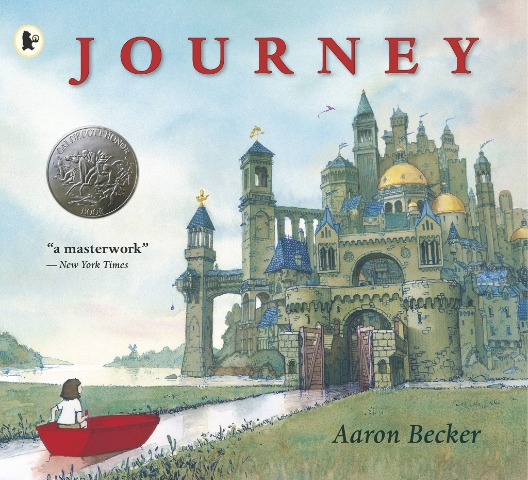
Journey by Aaron Becker
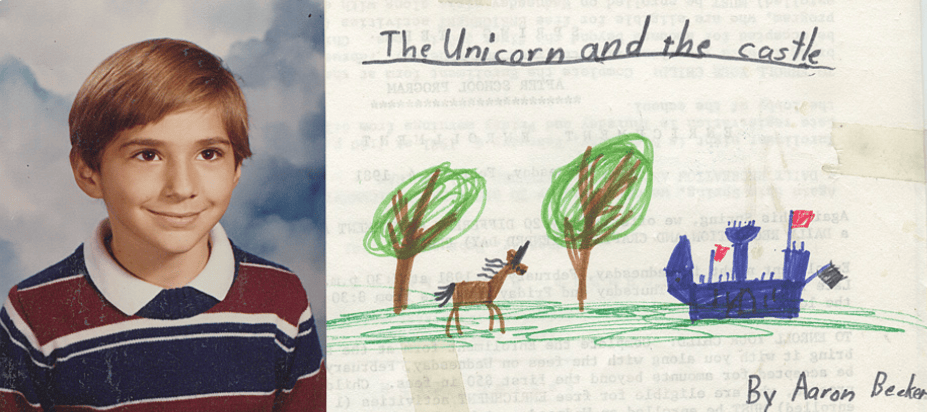
Let’s discover the author together! Who would like to read?
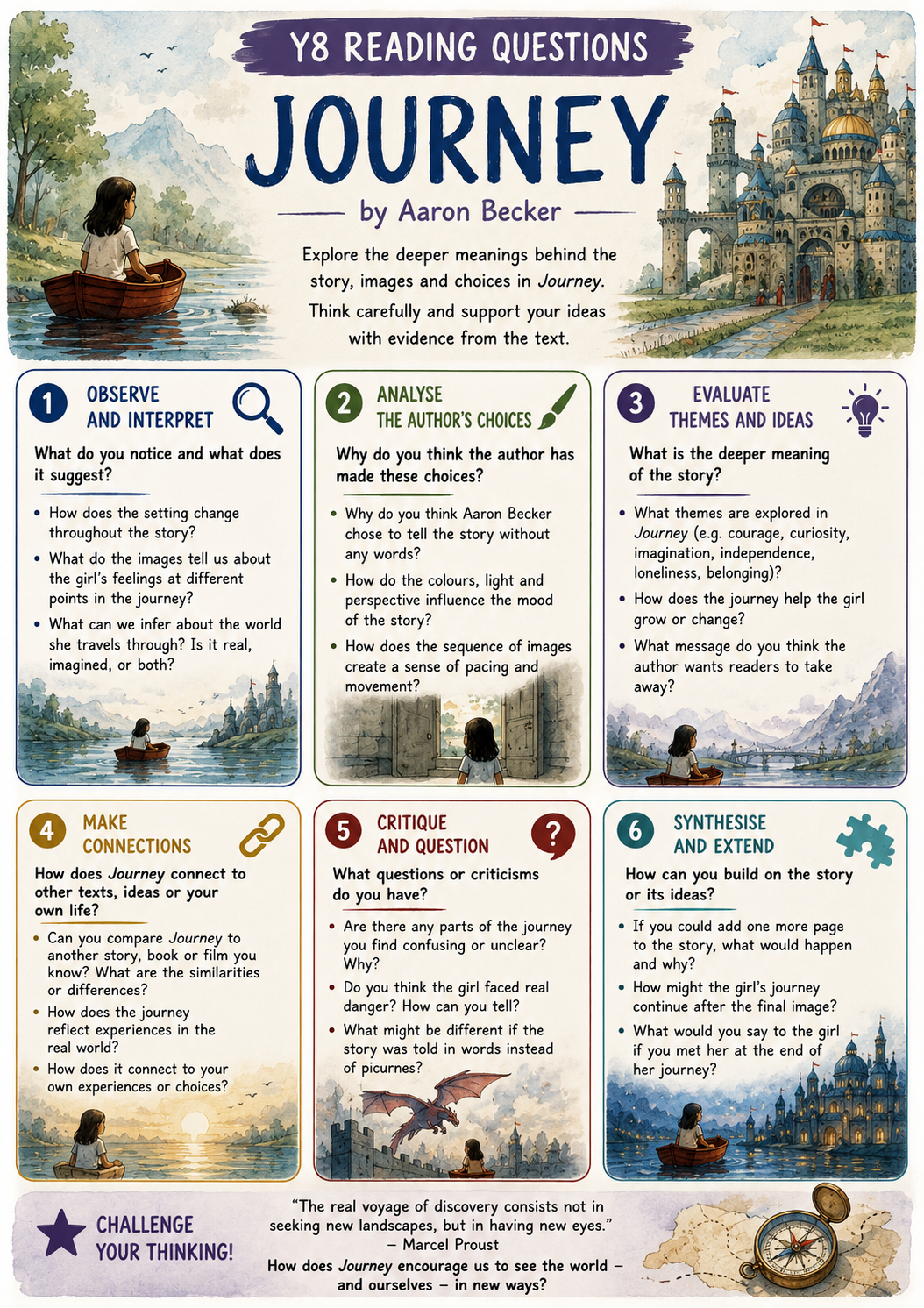
Pre-reading Questions
- Before opening the book, what might the title Journey suggest beyond simply travelling somewhere?
- Study the cover. What can you infer about the character from her position, surroundings and actions?
- How does Becker use colour to direct your attention?
- What might the contrast between ordinary and fantastical elements suggest?
- Why might an author deliberately choose to tell a story without words?
- Does removing words give the reader more or less control over the meaning of a story?
- Can an image be interpreted differently by different readers? Why?
- What might a journey represent symbolically?
- Why do people sometimes want to escape from their everyday lives?
- What is the difference between being alone and being lonely?
- How might imagination give someone freedom or power?
- What themes would you expect from this cover? What visual evidence supports your prediction?
- How might your own experiences influence the way you interpret these images?
- Who has more power in a wordless story: the author or the reader? Defend your initial view.
Y8 challenge: If there are no words to tell us what a character thinks or feels, how can an illustrator persuade us to interpret the character in a particular way?
Notes
Literal: writing the definition of an element exactly as it is.
What is a journey? A journey can be defined as…
- Physically travelling to a destination
- going on a plane ride
- exploring the wild
- an adventure
- rollercoaster that can affect your mental or physical state of being
Y8 challenge: If there are no words to tell us what a character thinks or feels, how can an illustrator persuade us to interpret the character in a particular way?
- using vivid imagery
- showing characters emotions through their drawings
- shadows
- specific colours
Writing Task:
As we read the story, add a bulleted list of notes of elements you notice.
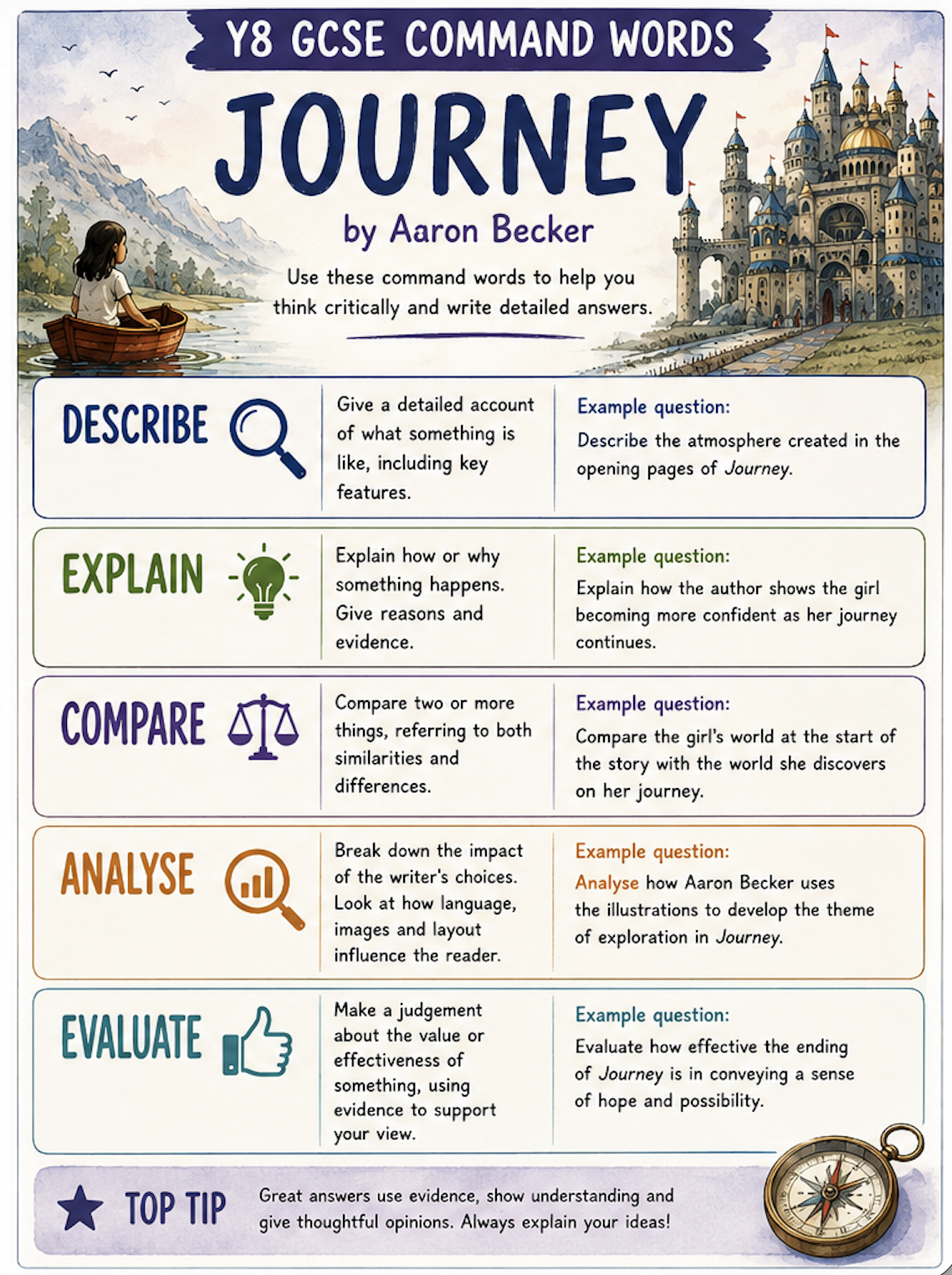
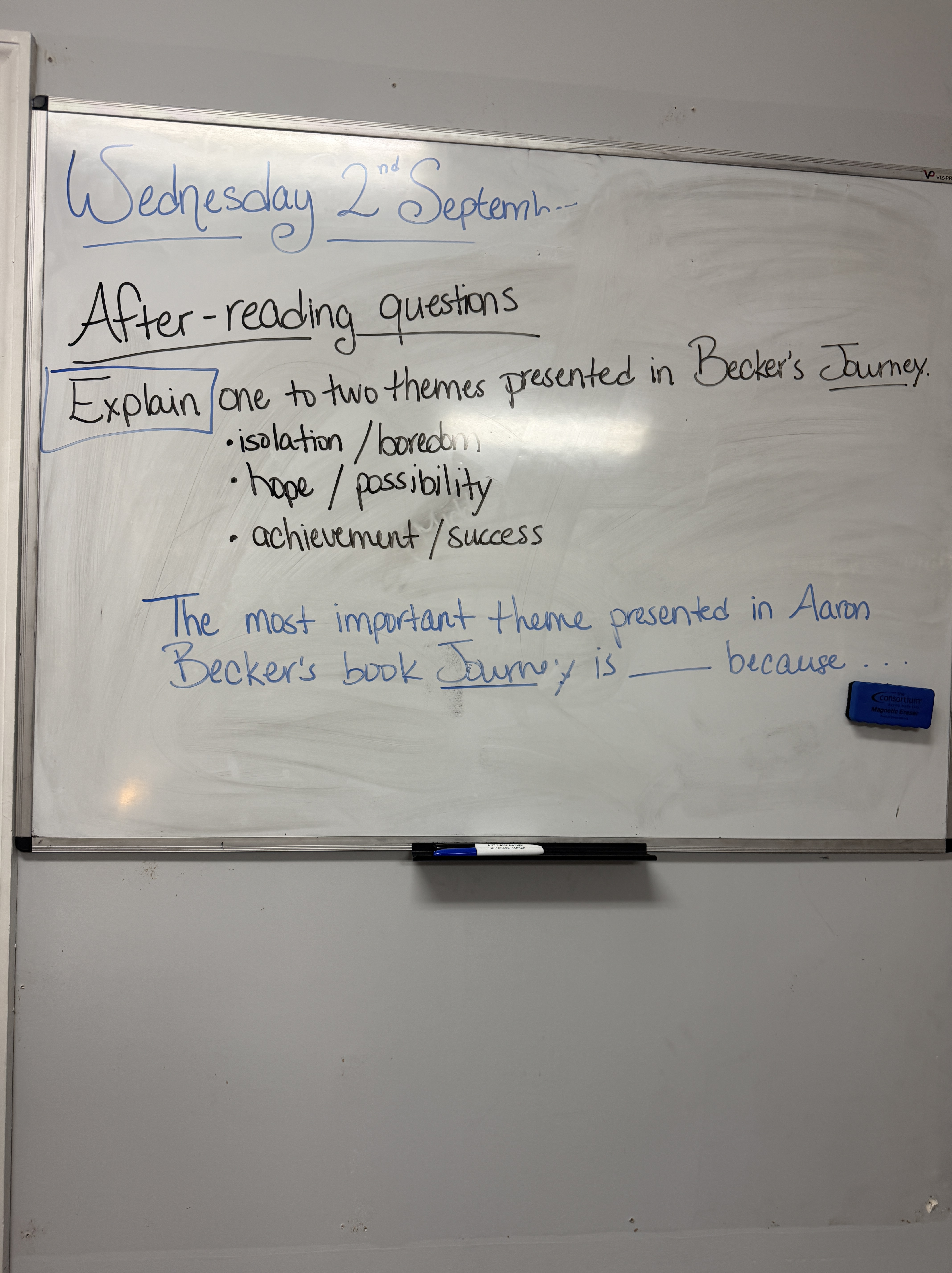
Notes from Class
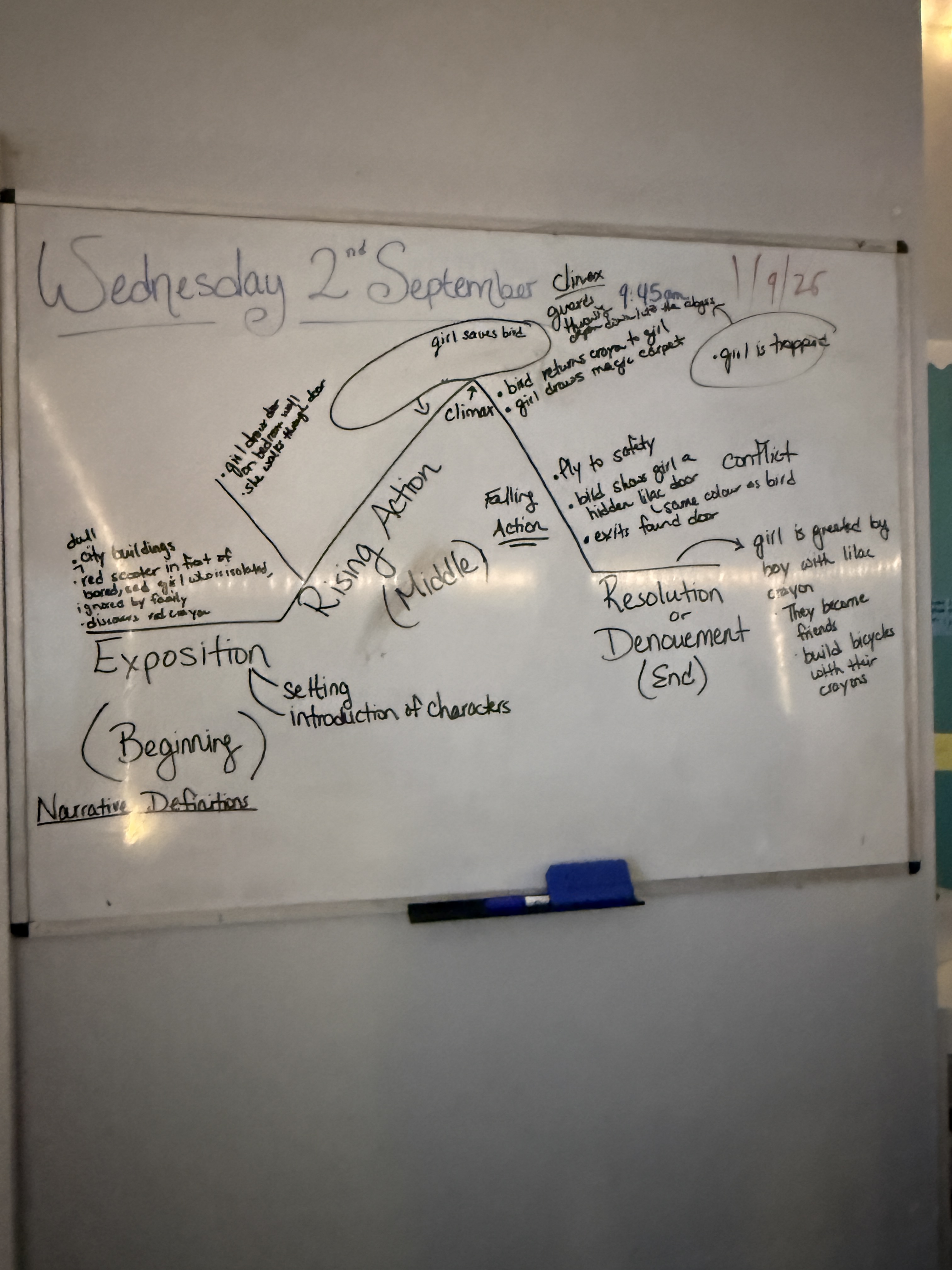
Every week, I will post pictures from key notes we discussed in class. Please use these pictures as reference points to help you move forward with your assignments. As always, if you have questions, please email me at Danielle.conti@footsteps.ky and I will reply between 8-6pm, Monday-Friday.
What’s on the horizon?
On Tuesday, you will sit for your first independent writing assignment this school year.
Task: You have 60 minutes to write a fantasy narrative about a journey that changes someone emotionally or spiritually. Your story should be at least one side in length. You may use the image for ideas if you wish, but you do not have to.

You should consider:
- Creating an interesting setting and atmosphere that engages your reader.
- Developing a character whose thoughts, feelings or outlook change during the journey.
- Organising your story clearly, with an effective beginning, development and ending.
- Using description and imagery to help your reader picture important places, characters and events.
- Varying your sentence structures and using punctuation accurately for meaning and effect.
- Choosing interesting and precise vocabulary that suits the mood of your story.
- Using paragraphs effectively to organise ideas and events.
- Checking your spelling, punctuation and grammar carefully.
Plan your ideas in the box below before you write.
Think about:
- Where does the journey begin and end?
- Why does your character go on the journey?
- What challenges or discoveries do they encounter?
- How does your character feel at the beginning?
- What important moment changes them?
- How are they different by the end?
Struggling with types of changes? See below.
- Emotional change – becoming happier, calmer, more hopeful or more confident.
- Change in attitude – seeing a person, place or situation differently.
- Growing in confidence – overcoming fear, doubt or insecurity.
- Learning a lesson – understanding something important about themselves or others.
- Becoming more independent – learning to make decisions or cope without relying on others.
- Overcoming a fear – facing something they were previously afraid of.
- Changing a belief – questioning something they once thought was true.
- Learning to trust – becoming willing to rely on or open up to someone.
- Finding forgiveness – forgiving another person or letting go of anger.
- Accepting something – coming to terms with a loss, mistake or difficult situation.
- Finding a sense of purpose – discovering what matters to them or what they want from life.
- Becoming more grateful – appreciating people, relationships or things they previously took for granted.
- Developing empathy – understanding another person’s feelings or experiences.
- Maturing – becoming more responsible, thoughtful or aware of consequences.
- Spiritual change – feeling a stronger connection to nature, faith, other people or a sense of meaning.
Weekend Homework: Refer to the independent writing sheet I assigned in class. Draw a plot diagram in the assigned box and plan out your narrative accordingly. Use our in-class example above if you need help. See you on Tuesday!
Spellings Week 1
Week 1
- afterthought
- elbows
- disgusting
- fiery
- failure
- heroes
- hymn
- idiotic
- macaroni
- lollipop
- ballad
- monopoly
- nastily
- oasis
- ovary
- patrolled
- pyjamas
- queue
- robbery
- tactics
In order to prepare for your spelling quizzes, please complete the following tasks:
- Write the part of speech for each term (noun, verb, adjective, adverb, etc.). This information can be found in any physical or Oxford English Dictionary online. You may also use Merriam Webster’s dictionary; however, you must be careful to use the British spelling of all terms.
- Write the definition.
- Use the word in an original sentence and underline/ highlight the word.
- Practice spelling each term x100000.
How you choose to study is up to you. Choose a path and stick to it. Here are some examples below:
- You may complete this task in a composition notebook that you keep for the year.
- You may create quizlet flashcards that you share as a class.
- You may create physical notecards that you use to quiz yourself on spelling.
Get creative and have fun. See my example below.
Week 1 Definitions and Example Sentences
- afterthought
Part of speech: Noun
Definition: An idea or action that is considered or added later.
Example sentence: The extra paragraph seemed like an AFTERTHOUGHT rather than part of the original plan. - elbows
Part of speech: Plural noun
Definition: The joints in the middle of the arms where they bend.
Example sentence: He rested his ELBOWS on the table while reading. - disgusting
Part of speech: Adjective
Definition: Extremely unpleasant or offensive.
Example sentence: The rubbish had been left so long that it produced a DISGUSTING smell. - fiery
Part of speech: Adjective
Definition: Full of fire or flames; also used to describe something very hot, passionate or strong-tempered.
Example sentence: The FIERY sunset filled the sky with brilliant shades of orange and red. - failure
Part of speech: Noun
Definition: A lack of success in doing or achieving something.
Example sentence: Rather than seeing the experiment as a FAILURE, the scientists learnt from the results. - heroes
Part of speech: Plural noun
Definition: People admired for their courage, achievements or admirable qualities.
Example sentence: The firefighters were praised as HEROES for their bravery. - hymn
Part of speech: Noun
Definition: A religious song or poem of praise, often sung during worship.
Example sentence: The congregation sang a traditional HYMN at the beginning of the service. - idiotic
Part of speech: Adjective
Definition: Extremely foolish or lacking good judgement.
Example sentence: Climbing over the safety barrier was an IDIOTIC thing to do. - macaroni
Part of speech: Noun
Definition: A type of pasta formed into small, narrow tubes.
Example sentence: We made MACARONI cheese for dinner. - lollipop
Part of speech: Noun
Definition: A sweet on the end of a small stick.
Example sentence: The child chose a strawberry LOLLIPOP from the shop. - ballad
Part of speech: Noun
Definition: A poem or song that tells a story, often about love, adventure or tragedy.
Example sentence: The poet wrote a BALLAD about a sailor lost at sea. - monopoly
Part of speech: Noun
Definition: Complete or dominant control of the supply or trade of a particular product or service.
Example sentence: The company was accused of creating a MONOPOLY by preventing competitors from entering the market. - nastily
Part of speech: Adverb
Definition: In an unpleasant, unkind or spiteful manner.
Example sentence: She spoke NASTILY to her classmate and later apologised. - oasis
Part of speech: Noun
Definition: A fertile area in a desert where water is available; also a peaceful or pleasant place surrounded by difficulty.
Example sentence: After hours of travelling through the desert, the travellers finally reached an OASIS. - ovary
Part of speech: Noun
Definition: An organ in a female animal that produces egg cells; in a flower, the part that contains the ovules.
Example sentence: The scientist examined the OVARY of the flower to identify its developing seeds. - patrolled
Part of speech: Verb (past tense)
Definition: Moved regularly around an area to watch, guard or protect it.
Example sentence: Police officers PATROLLED the streets during the festival. - pyjamas
Part of speech: Plural noun
Definition: Loose clothing worn for sleeping.
Example sentence: Before going to bed, Sam changed into his PYJAMAS. - queue
Part of speech: Noun
Definition: A line of people or vehicles waiting for something.
Example sentence: We joined the QUEUE outside the theatre and waited for the doors to open. - robbery
Part of speech: Noun
Definition: The crime of taking money or property from a person or place by force or threat.
Example sentence: The police interviewed several witnesses after the ROBBERY. - tactics
Part of speech: Plural noun
Definition: Carefully planned methods used to achieve a particular result.
Example sentence: The team changed its TACTICS during the second half of the match.


