Lesson 1: Letter to Teacher
Lesson 1 Writing Task- Letter to Teacher
Directions: Write a letter to your teacher– an introduction, so to speak. Use paragraphs to separate your ideas.
- Tell me about your interests as a reader. What genre appeals to you? Why?
- What interests you about literature?
- What are your personal goals for this English 7 class?
- What are you expecting from Year 7? How will school change? How will you change?
- What else is important for me to know? Anything school appropriate goes!
Sentence Starters
Introducing yourself
- I would like to tell you a little about myself…
- One thing you should know about me is…
- If I had to describe myself, I would say…
My interests as a reader
- When it comes to reading, I enjoy…
- My favourite genre is… because…
- I am particularly interested in books that…
- A book or author I have enjoyed is…
- I find reading more enjoyable when…
My thoughts about literature
- What interests me most about literature is…
- I enjoy exploring…
- Literature can be interesting because…
- One aspect of English that I would like to learn more about is…
My goals for English
- One of my goals for English this year is…
- I would particularly like to improve my…
- I sometimes find _____ challenging, so I hope to…
- By the end of Year 7, I would like to be able to…
My expectations for Year 7
- This year, I expect…
- I think Year 7 will be different because…
- One change I am looking forward to is…
- This year, I hope to become more…
- I plan to take more responsibility for…
Anything else
- Something else that is important to know about me is…
- Outside of school, I enjoy…
- I work best when…
- Something that motivates me is…
- Finally, I would like you to know that…
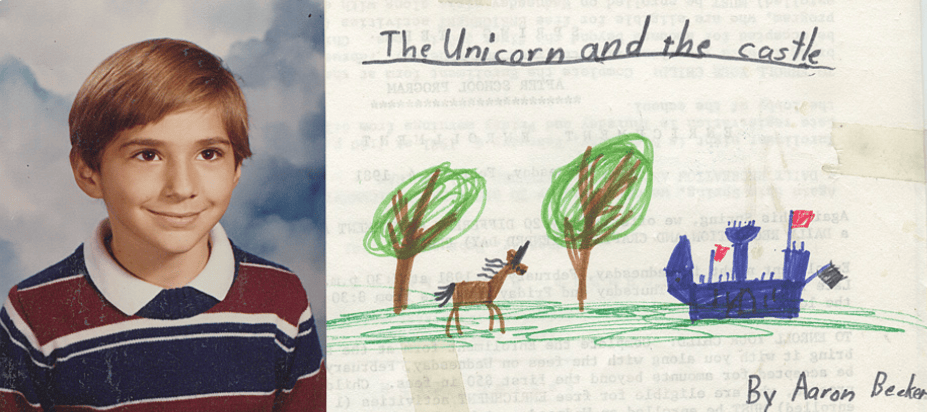
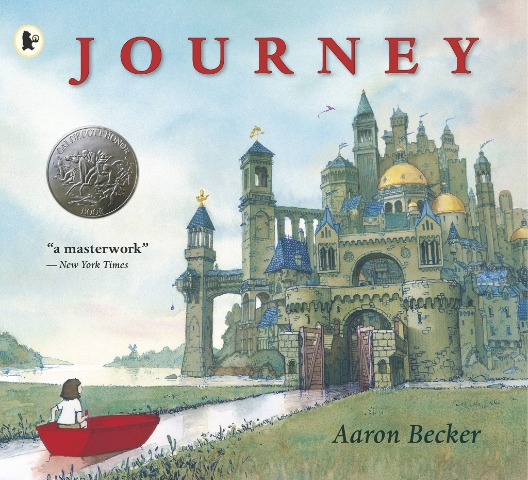
Journey by Aaron Becker
Let’s discover the author together! Who would like to read?
Remember to read with purpose!
- Do you have your highlighter?
- Do you have a pen for marginal notes?
Pre-reading Questions
Red Practice Book (Independent Writing)
Answer the questions below using brief, full sentences. (Do not write the question.)
- What do you notice first about the front cover? Why does your eye go there?
- What might the title Journey suggest about the story?
- What clues can you find about where the character might go?
- What do you predict the red object will be used for?
- What mood does the cover create? Which visual details create this mood?
Y7 challenge: How can a journey change a person? Explain your prediction.
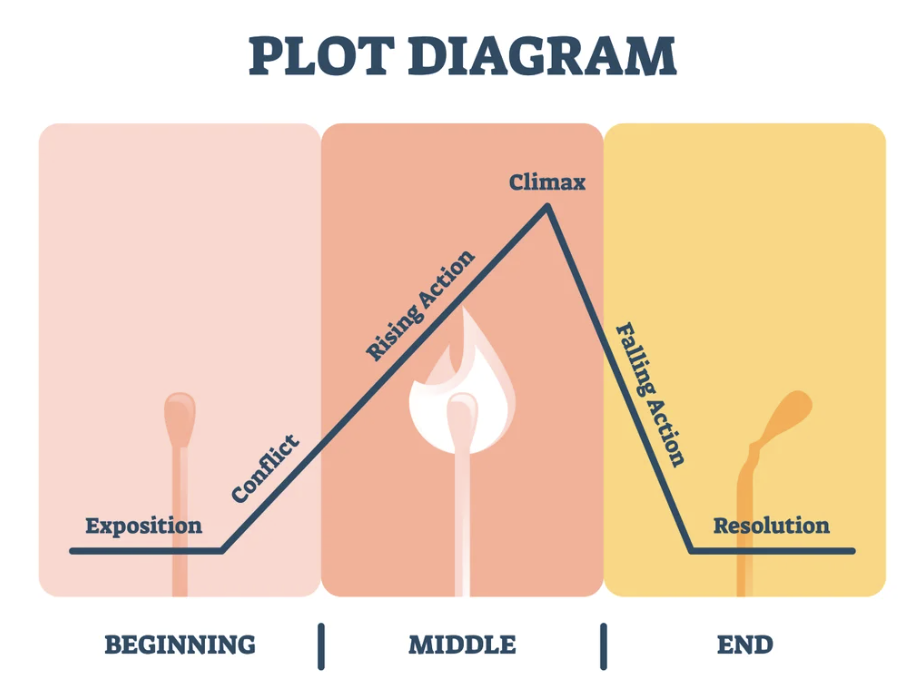
Before we move on, draw a large plot diagram in your book. It should take up two (2) whole pages.
Aloud (Whole Group)
- What can we infer about the girl’s life at the beginning?
- What predictions do you have about this young girl’s journey? Write them in a quick bulleted list now.
- How do you think she feels? What visual evidence supports your answer?
- How do the other members of her family respond to her?
- Why might Becker use mostly muted colours at the beginning?
- Why is the red crayon so noticeable?
- What might the red crayon symbolise?
- How does Becker show the difference between the ordinary world and the imaginary world?
- How can we infer meaning from pictures?
- How we show empathy and understanding?
- How can we use colours and their connotations to extract and explore meaning?
- What do facial expressions tell us about how someone is feeling?
Remember our flaps!
As we read, let’s refer to our reading questions and command words for help in explaining out thoughts.
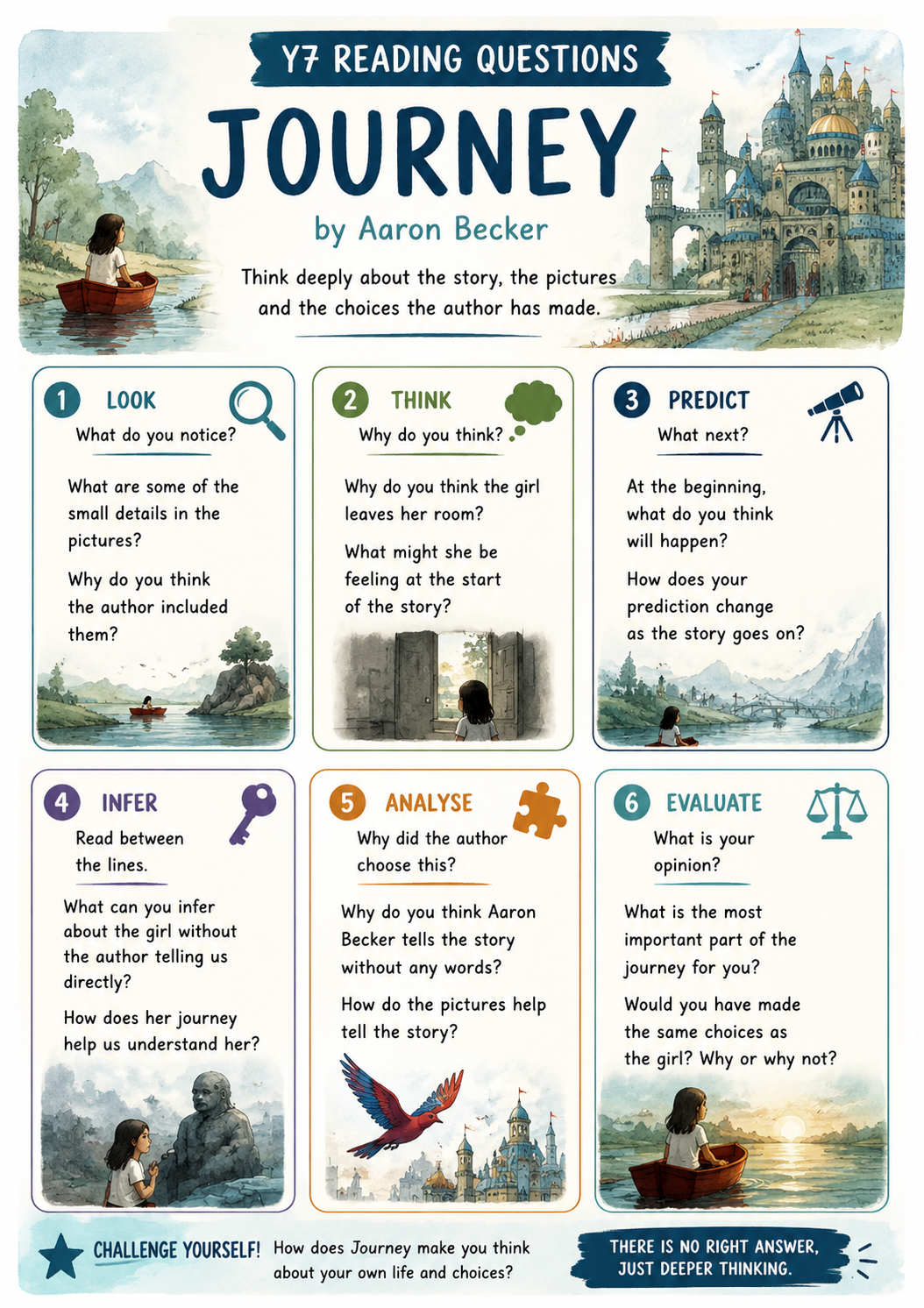
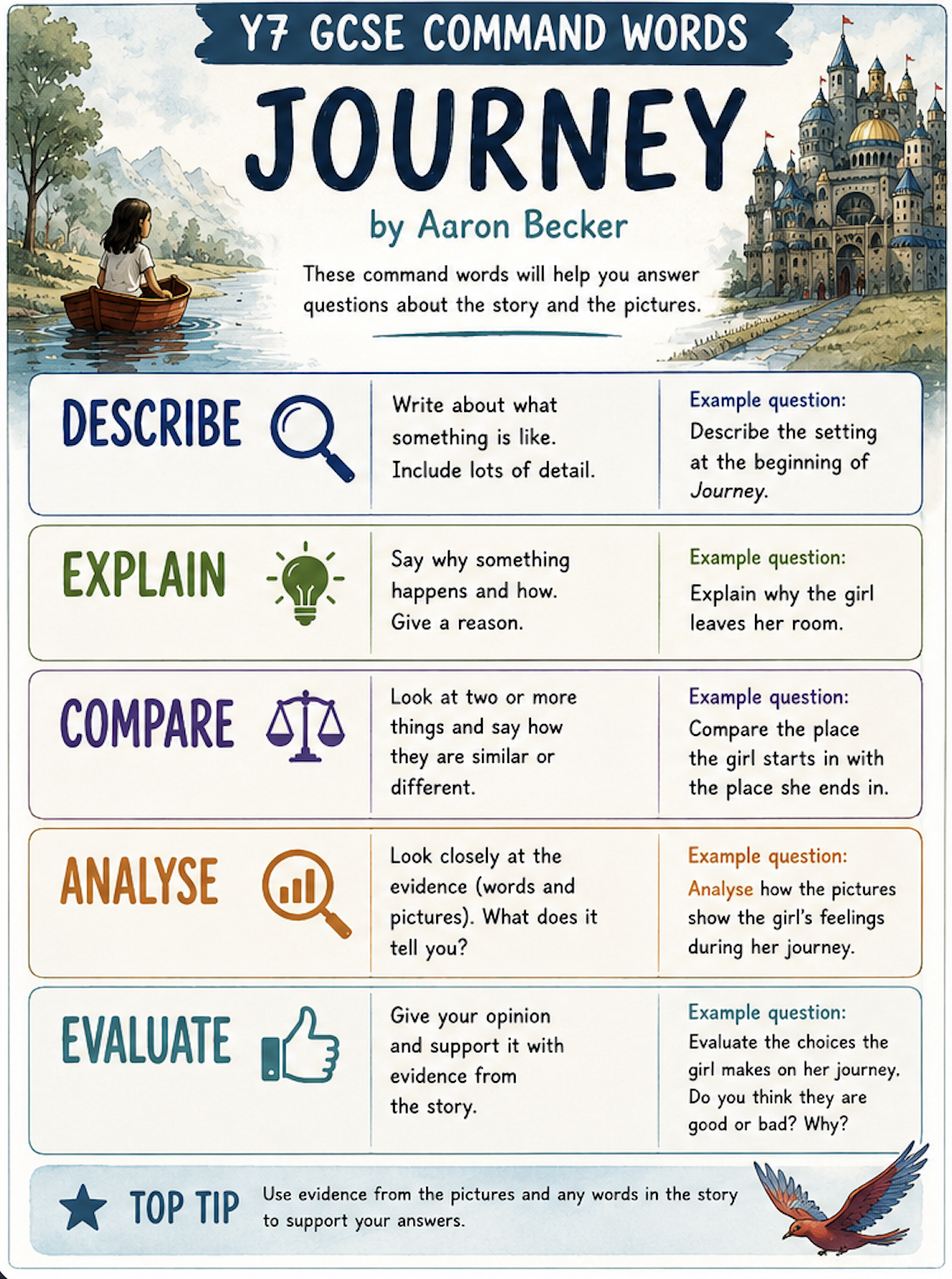
YEAR 7 READING PROMPTS:
- What were your predictions? Why? Were they correct?
- Can you relate any of the events or characters to yourself? Which and how?
- Does this book make you think of any other books that you have read? How and why?
- What does this book teach you about the world?
- If you had to summarise this story in a few sentences, what would you say?
Notes from Class
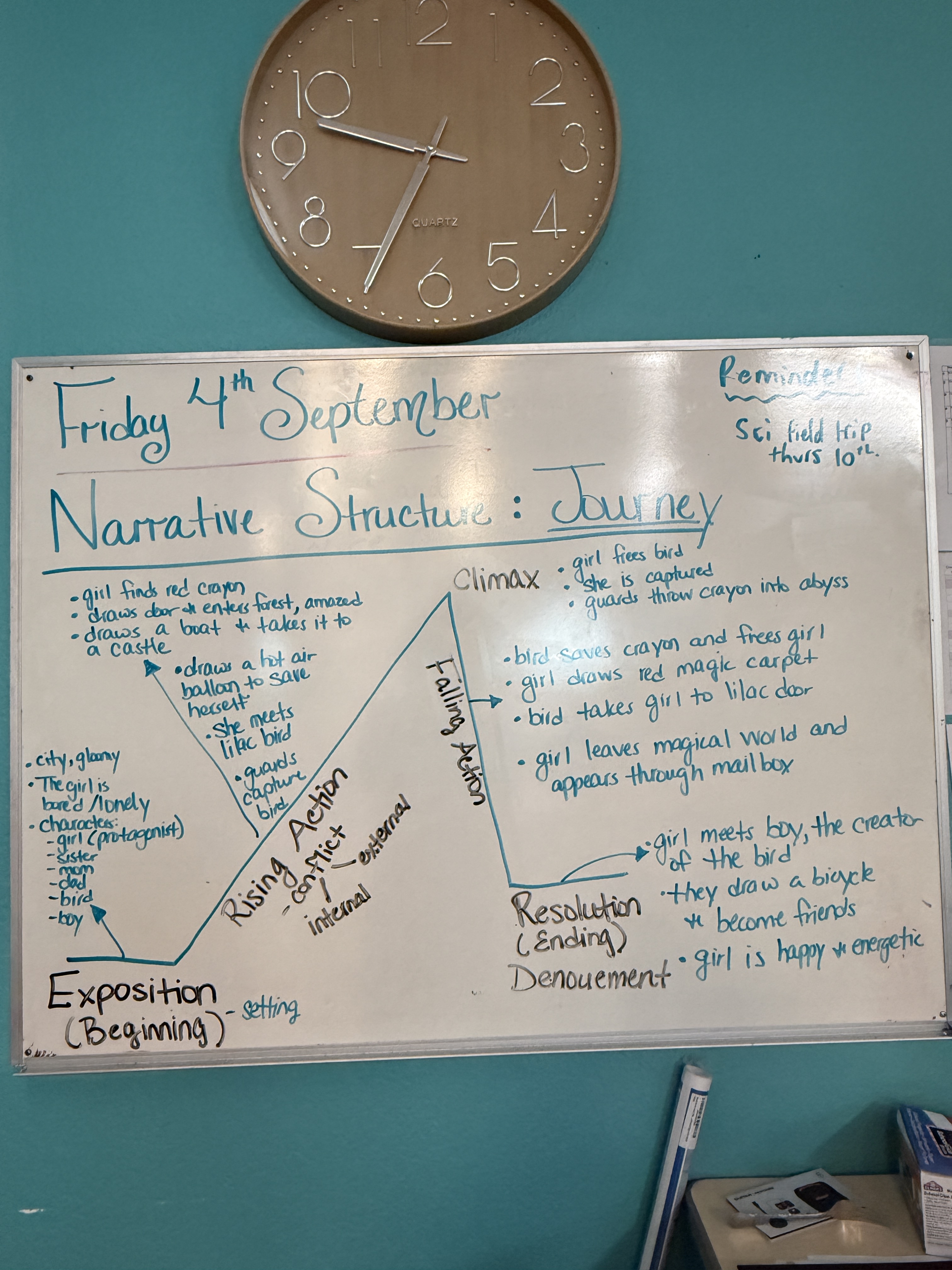
Narrative Structure: Journey
What’s coming up?
You will complete your first Independent Writing assignment on Monday.
Task: You have 60 minutes to write a story called The Adventure.
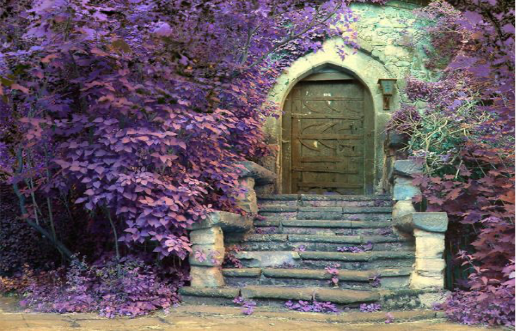
It should be at least 1 side in length. You may use this image for ideas if you wish, but you do not have to.
You should consider:
- Content, purpose and the language that you use to engage your audience
- Text structure and how you organise your writing as a whole
- Sentence structures and how you use punctuation to add meaning and effect
- Interesting vocabulary choices and your spelling
Think, Pair, Share:
Go ahead and plan out your story now.
- Draw a plot diagram on this sheet of paper.
- Plan out what major events should go in each section.
- Share your ideas with a partner.
Weekend Homework: Refer to the independent writing sheet I assigned in class. Draw a plot diagram in the assigned box and plan out your narrative accordingly. Use our in-class example above if you need help. See you on Monday!
Spellings Week 1
Week 1
- accident
- circuit
- circumstance
- discipline
- decimal
- citizen
- recent
- decision
- cyclone
- cemetery
- incense
- mercy
- cyst
- bicycle
- ceiling
- decide
- civil
- city
- centigrade
- receive
In order to prepare for your spelling quizzes, please complete the following tasks:
- Write the part of speech for each term (noun, verb, adjective, adverb, etc.). This information can be found in any physical or Oxford English Dictionary online. You may also use Merriam Webster’s dictionary; however, you must be careful to use the British spelling of all terms.
- Write the definition.
- Use the word in an original sentence and underline/ highlight the word.
- Practice spelling each term x100000.
How you choose to study is up to you. Choose a path and stick to it. Here are some examples below:
- You may complete this task in a composition notebook that you keep for the year.
- You may create quizlet flashcards that you share as a class.
- You may create physical notecards that you use to quiz yourself on spelling.
Get creative and have fun. See my example below.
Week 1 Definitions and Example Sentences
- accident
Part of speech: Noun
Definition: An unexpected event that causes damage, injury or harm.
Example sentence: The broken window was an accident, so nobody was punished. - circuit
Part of speech: Noun
Definition: A complete route around an area, or a complete path through which an electric current can flow.
Example sentence: The bulb lit up when we completed the electrical circuit. - circumstance
Part of speech: Noun
Definition: A fact or condition that affects a situation or event.
Example sentence: Under normal circumstance, the library closes at five o’clock. - discipline
Part of speech: Noun
Definition: The ability to control your behaviour and follow rules, or a particular area of study.
Example sentence: Training for the competition required patience and discipline. - decimal
Part of speech: Noun
Definition: A number expressed using a decimal point to show a value that is not necessarily a whole number.
Example sentence: Write the fraction as a decimal before completing the calculation. - citizen
Part of speech: Noun
Definition: A person who legally belongs to a particular country.
Example sentence: Every citizen has rights as well as responsibilities. - recent
Part of speech: Adjective
Definition: Happening or beginning only a short time ago.
Example sentence: A recent storm caused several trees to fall. - decision
Part of speech: Noun
Definition: A choice made after thinking about different possibilities.
Example sentence: Choosing which secondary school to attend was an important decision. - cyclone
Part of speech: Noun
Definition: A powerful storm in which strong winds move in a circular pattern around a central area.
Example sentence: The approaching cyclone brought extremely strong winds and heavy rain. - cemetery
Part of speech: Noun
Definition: An area of land where people who have died are buried.
Example sentence: The old cemetery contained gravestones that were hundreds of years old. - incense
Part of speech: Noun
Definition: A substance that produces a strong, pleasant smell when it is burnt.
Example sentence: The smell of incense filled the ancient temple. - mercy
Part of speech: Noun
Definition: Kindness or forgiveness shown towards someone whom you have the power to punish or harm.
Example sentence: The defeated soldier begged his opponent for mercy. - cyst
Part of speech: Noun
Definition: A small sac or lump in the body that contains liquid or other material.
Example sentence: The doctor examined the cyst carefully before deciding on treatment. - bicycle
Part of speech: Noun
Definition: A vehicle with two wheels that is moved by pushing pedals with your feet.
Example sentence: She rode her bicycle along the cycle path to school. - ceiling
Part of speech: Noun
Definition: The inside surface that forms the top of a room.
Example sentence: A bright light hung from the centre of the ceiling. - decide
Part of speech: Verb
Definition: To make a choice after considering the available possibilities.
Example sentence: We need to decide which route to take before we begin our journey. - civil
Part of speech: Adjective
Definition: Relating to ordinary citizens and their society, or polite and respectful in behaviour.
Example sentence: Although they disagreed, the two students remained civil towards each other. - city
Part of speech: Noun
Definition: A large and important town where many people live and work.
Example sentence: The city centre was crowded with shoppers and tourists. - centigrade
Part of speech: Adjective
Definition: Relating to the temperature scale in which water freezes at 0 degrees and boils at 100 degrees.
Example sentence: The temperature reached thirty degrees centigrade during the afternoon. - receive
Part of speech: Verb
Definition: To be given, sent or presented with something.
Example sentence: Every student will receive a certificate after completing the course.


